
Blended Learning Labs
Asynchronous content will be available in NATA EducATe by May 4, 2026.
Registration closes May 31, 2026.
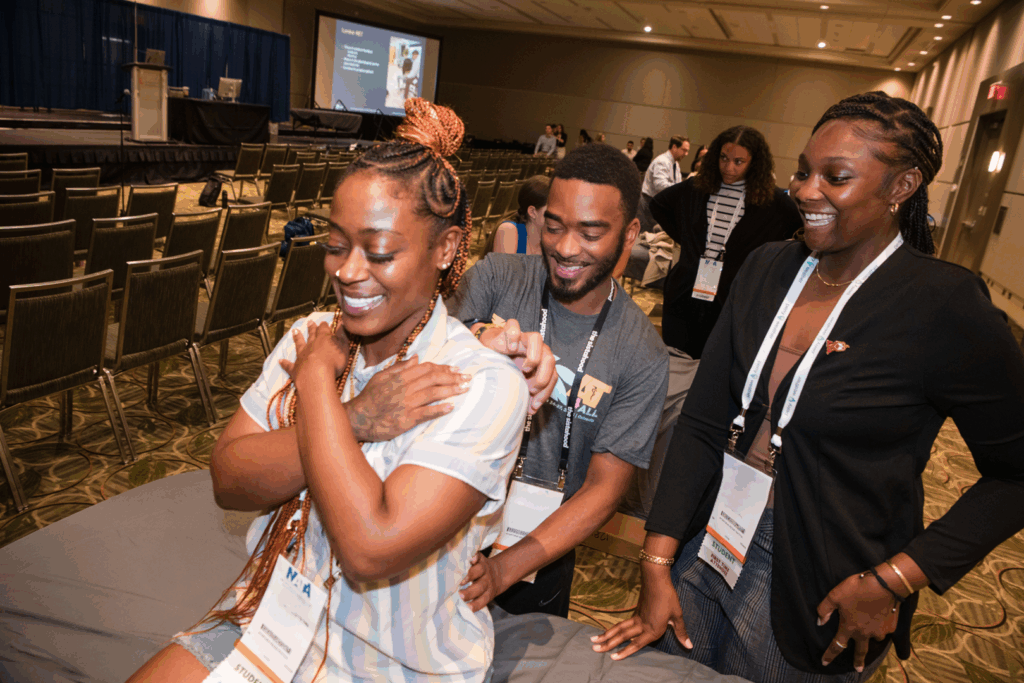
Advance your clinical techniques and analytical thinking with NATA’s Blended Learning Labs: dynamic 3-hour sessions that combine 1 hour of asynchronous online learning with 2 hours of in-person, interactive labs.
Designed to immerse you in practical, domain-specific skills, these labs provide hands-on experiences guided by experts in the field.
Blended Learning Labs offer a unique opportunity to observe, analyze and apply new techniques under expert guidance, ensuring you leave with skills you can immediately implement in your practice.
Pre-registration is required, and space is limited, so be sure to reserve your spot early. Please note that the asynchronous content must be completed prior to the in-person lab; failure to do so will result in ineligibility to participate onsite.
Completion of the asynchronous portion of the Blended Learning Lab earns an additional 1 CEU beyond your regular convention credits, which will be issued immediately upon completion of the work in EducATe.
Member
$25
Nonmember
$35
LL4: Creating Master Adaptive Athletic Trainers: Using Coaching to Foster Self-Regulation and Mitigate Burnout
Tuesday, June 30, 2026, 10:00 a.m. – 12:00 p.m.
Becky Bliss, PT, DPT, DHSc, University of Kansas Medical Center, (V), (BCS-O III), Advanced
There is a growing need to equip athletic trainers (ATs) with tools to navigate the evolving demands of clinical practice, including high stress, role overload, and increasing rates of burnout.
While the Master Adaptive Learner (MAL) framework and coaching strategies are well-supported in health professions education to foster self-regulation and lifelong learning, they remain underutilized in athletic training. This creates a performance and competency gap in developing resilient, adaptive practitioners. Closing this gap is critical to supporting AT well-being, promoting reflective practice, and ultimately improving patient care and professional longevity in a field experiencing high attrition and increasing complexity.
Learning Objectives
- Describe the key components of the Master Adaptive Learner framework and its relevance to the professional development of athletic trainers.
- Analyze how coaching strategies can support self-regulated learning and adaptive expertise in the context of athletic training practice.
- Develop a personalized action plan to integrate coaching principles and self-reflection techniques aimed at reducing burnout and enhancing professional growth.
LL15: NFL to Friday Night Lights: Building a Concussion Identification System Into Your Game Day Protocols (I, III, V), Advanced
Wednesday, July 1, 2026, 9:00 a.m. – 11:00 a.m.
It is a misconception that a concussion identification system is not achievable in the secondary school and collegiate settings. Using the National Football League’s program as a model, attendees will learn how develop their own system utilizing existing resources at their institution. Attendees will have an opportunity to participate in simulated scenarios and apply these concepts in developing their own educational programming for non-medical personnel.
Learning Objectives
- Describe a plan for identifying head injury behavior in their practice.
- Create an education/ training plan for non-medical personnel.
- Consider how to train non-medical personnel on the signs of a patient concussion deterioration.
- Define clinical metrics to demonstrate the value of their program.
LL8: Utilizing Repeated Motions Assessment and Cluster Tests to Improve Your Examination of Cervical Spine Disorders (II, IV), (BCS-O I, II, III), Advanced
Thursday, July 2, 2026, 9:00 a.m. – 11:00 a.m.
Kenneth Cieslak, DC, ATC, CSCS, Atlantic Sports Health
David Gallegos, MA, ATC, Cert. MDT, Southwest Sport & Spine, Inc.
Athletic Trainers are often tasked with assessing and managing non-catastrophic disorders of the cervical spine. Determining origin of tissue involvement is vital to planning an effective treatment strategy to maximize treatment outcomes and minimize time loss. This presentation will review cervical spine anatomy and mechanics as a prelude to developing an examination process to determine how to best manage these conditions. Through lecture and lab activities, an efficient examination process will be discussed, as well as tips for rehabilitation and self-management. The goal is to instill confidence and mastery in dealing with cervical spine disorders for the practicing clinician.
Learning Objectives
- Identify the anatomy and mechanics of the cervical spine, emphasizing the unique characteristics to consider for this region, and how it impacts injury rates and examination strategies.
- Apply a clinical examination process that is tailored to findings encountered in the history and initial assessment, with an emphasis on meaningful provocative testing strategies, and end-range loading approaches.
- Select initial treatment strategies that are determined by whether nociceptive or neuropathic findings predominate in the assessment process, and if a directional preference is encountered.
- Identify key determinants in the examination process, as well as clinically relevant management strategies.
LL26: Fueling Readiness & Recovery: Integrating Sleep, HRV, Menstrual Cycle, and Force-Plate Readiness Tracking in Female Collegiate Athletes (I, II, IV V), Advanced
Thursday, July 2, 2026, 12:15 p.m. – 2:15 p.m.
Donita Valentine, DAT, LAT, FST3, Function Junction AT
While sleep, HRV and force-plate data are increasingly recognized as key indicators of readiness, many athletic trainers lack integrated, actionable methods especially when addressing menstrual cycle influences in female athletes. In this lab, attendees will learn how one collegiate volleyball program combined the Pittsburgh Sleep Quality Index, HRV and cycle tracking via non-branded app, and force-plate assessments to create a holistic, individualized readiness score that supports data-informed decision-making in real time.
Learning Objectives
- Interpret relationships among sleep scores, HRV trends, menstrual-phase data, and force-plate readiness metrics.
- Apply a validated framework to assess weekly athlete readiness across multiple physiological domains.
- Differentiate phases of the menstrual cycle and targeted readiness adjustments applicable to female athletes.